

There’s a moment many women reach in their early to mid-40s where something shifts. It’s subtle at first… and then undeniable. Your body feels different. Your tolerance drops. The way you’ve been living no longer fits. And somewhere deep inside, a quiet voice begins asking, Is this really how I want to live the rest of my life?
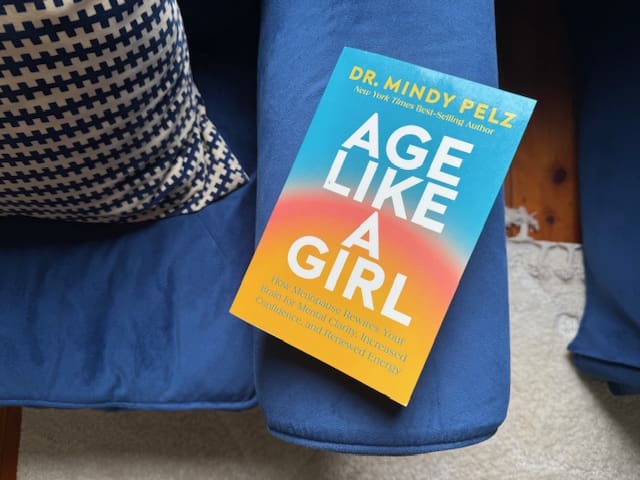
Age Like a Girl by Dr Mindy Pelz is a powerful and reassuring guide for that exact moment.
This is a great read. It’s grounded in science, yet deeply human. It offers practical insights into what is happening hormonally and neurologically during midlife, but more importantly, it reframes menopause as something far more meaningful than a biological inconvenience. It positions it as a profound stage of human growth and development.
And that shift in perspective is everything.
Menopause as a Turning Point, Not a Decline
Dr Pelz reframes menopause as an awakening rather than a loss. She describes it as a time when the body and brain begin reflecting back what is and isn’t working in your life. A moment of reckoning. A call to pause, reassess, and realign. As she writes, “the neurochemical shift at menopause offers a mirror… an opportunity to change what no longer works in our life.”
For many women, this shows up as exhaustion, irritability, anxiety, brain fog, or a deep sense of disconnection. But instead of seeing these as problems to fix, she invites us to see them as signals – guiding us back to ourselves.
That insight alone felt incredibly validating.
The Five Stages of Alchemising Through Menopause
One of the most powerful frameworks in the book is what she calls the five stages of transformation through menopause.
Rather than a purely physical process, she presents this as an emotional, psychological and even spiritual journey, one that mirrors a kind of rebirth.
- The Hunch – that inner knowing that something isn’t right anymore
- The Shedding – where old patterns, roles and identities begin to fall away
- The Grief – the necessary mourning of who you’ve been
- The Initiation – stepping into alignment with your truth
- The Return – emerging as your most authentic self
This framework beautifully captures what so many women experience but often can’t articulate.
That feeling of “my life looks fine on paper, but something feels off”. The discomfort of outgrowing roles you once worked so hard to build, but now leave you feeling exhausted. The emotional intensity that seems to come out of nowhere. It’s not random, it’s transformation.
The Unravelling… and the Becoming
What I found particularly powerful is how honestly the book speaks to the unravelling that can happen in midlife.
There’s a recognition that many women have spent decades over-functioning, pleasing others, managing everything, and striving to feel worthy. And eventually, the body calls time on that way of living. As Dr Pelz reflects, there comes a point where your whole system simply says, no more.
This can feel disorienting, even frightening. But she reframes it as a necessary dismantling, a shedding of the identities, expectations and patterns that no longer serve you. She said for her, “it was raw. It was painful. It was necessary.”
The benefit is that on the other side of that dismantling is clarity, boundaries, self-trust and a deeper connection to who you actually are.
A New Narrative for Women in Midlife
At its core, this book is about reclaiming the narrative of ageing. Reframing old beliefs that it’s a decline, invisibility, and disempowering to being a necessary evolution. Dr Pelz invites us to see this stage as an upgrade, where energy once used for reproduction becomes available for creativity, leadership, purpose and impact. She reminds us that our bodies are not failing us, but guiding us. As she beautifully puts it, “women deserve a new narrative, one where aging is not something to be feared but something to be honored.”
Age Like a Girl is a deeply empowering read for any woman navigating menopause. It offers both understanding and permission.
Permission to slow down.
Permission to question everything.
Permission to say no.
Permission to choose yourself.
And perhaps most importantly, it offers a new way of seeing what can feel like chaos, not as something going wrong, but as something deeply right. A return to yourself.
If you’re in midlife and finding yourself wondering, what is happening to me – this book will not only help you understand… it will help you trust the process you’re in.




Comments +