There was a time in my life when I believed that if I could just think my way through things, I would be fine. It’s a belief that’s rewarded in high-performing environments. Logic is prized and rationality is respected. The ability to analyse, to weigh evidence and to arrive at a conclusion are the skills that build careers and reputations. They certainly built mine. For years, I lived almost entirely in that space.
On paper, my life made sense. I had achieved what I set out to achieve. I had become a lawyer, partner of a law firm and then a coroner. I was making decisions that mattered, operating in a world that demanded precision, objectivity, and control. From the outside, it looked like success.
But beneath the surface, something else was happening. I was exhausted, disconnected and quietly unravelling in ways I didn’t yet have the language to describe. There was a persistent feeling that something wasn’t quite right, even though I couldn’t logically understand why. And so, like many people do, I tried to think my way out of it. I read more, analysed more and nothing changed.
It wasn’t until much later that I began to understand why.
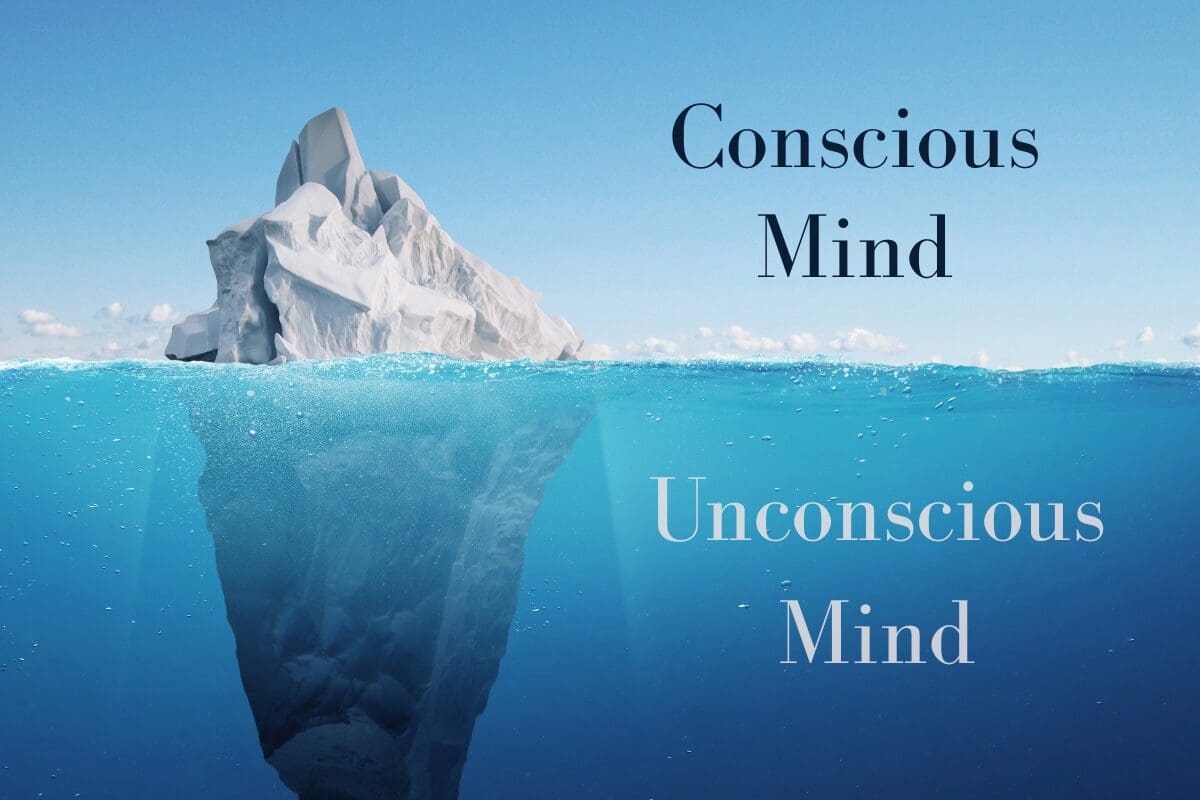
If you imagine the mind as an iceberg, only a small fraction sits above the waterline. That visible tip represents the conscious mind, the part responsible for logic, reasoning, and deliberate thought. It accounts for a surprisingly small portion of how we operate. Below the surface sits the unconscious mind. Vast, unseen, and far more influential. It holds our beliefs, emotional patterns, memories, and the automatic responses that shape how we experience the world.
This model was first introduced by Sigmund Freud and later expanded by Carl Jung, who explored the deeper layers of the psyche that quietly govern behaviour. More recent voices like Joe Dispenza and Bruce Lipton have translated these ideas into modern language, connecting them to neuroscience and the way habits and beliefs are formed.
What struck me, as I began to explore this work was how much of my life I had spent ignoring it. I had been trying to create change from the surface, from the 4%. And when you do that, you inevitably reach a ceiling. Because the unconscious mind actively shapes your decisions, your reactions, your sense of what is possible, often without your awareness. You can know what you should do, you can even want it deeply and still find yourself repeating the same patterns.
That was my experience.
The shift began with a willingness to go somewhere unfamiliar. To sit still long enough to notice what was underneath the constant mental noise. To pay attention to the emotions I had spent years overriding. To question the beliefs, I had accepted as truth without ever consciously choosing them.
It wasn’t comfortable.
There is a reason many people stay on the surface. It feels predictable and safe. The unconscious mind, by contrast, is less orderly. It asks different questions and reveals things we might prefer not to see. But it is also where transformation begins.
Through practices like meditation, journaling, breathwork, and later through modalities such as Neuro-Linguistic Programming and hypnosis, I subtly started to access a different layer of myself. Patterns that once felt fixed began to loosen, reactions that once felt automatic began to shift, and a sense of clarity emerged.
What I came to understand is that transformation is about uncovering what is already there and learning how to work with it.
I regularly observe this pattern in my work with women in midlife. Intelligent, capable women who have built successful lives, and yet feel a quiet disconnection they can’t quite explain. They have done everything “right,” and still something feels off. Almost always, they have been living from the surface. Trying to solve deeper misalignment with sharper thinking, control, or more effort. But the answers they are searching for exist beneath it.
To awaken is to become aware of the part of you that has been quietly functioning in the background. When you wake up to the beliefs you didn’t consciously choose, you realise that they are been informing your decisions long before logic entered the room. When you begin to access that space, you stop forcing your life into shape, you start responding rather than reacting and you begin to create from a place that feels aligned, rather than constructed.
The iceberg remains. The surface still matters and logic still has its place but it’s no longer the only tool you rely on. More importantly, with curiosity and compassion, you begin to know yourself better and trust your intuition.
That is where the real work begins. Beneath the surface.

Comments +