About two years ago I started thinking about how every stage of human life has a name: childhood, girlhood, adolescence, adulthood. We have words that hold these stages, honour them, give them cultural weight and recognition.
And then I started thinking about what comes next.
After adulthood. After the decades of doing, achieving, performing, building, and becoming everything to everyone. After the moment, and you’ll know this moment if you’ve lived it, when something quietly cracks open inside you and asks: is this it? Is this really all there is?
What do we call that stage?
It often gets called a midlife crisis, a breakdown, the second half, reinvention, the middle passage. Some of these are clinical. Some are dismissive, Most carry the suggestion that something has gone wrong – that this feeling is a problem to be solved, a phase to be managed, or a symptom to be medicated.
We don’t call it what it actually is.
The Word That Was Missing
A word kept coming back to me time and again over the last few year. It was a word I was looking for.
I wanted a word for the life stage that begins when adulthood starts to crack open. The stage when accumulated experience stops being something that happens to you and starts becoming something that lives in you. The stage when a woman stops performing the life expected of her and starts inhabiting the life that is truly hers.
I couldn’t find it. Because it didn’t exist.
So I coined one.
Wisdomhood.
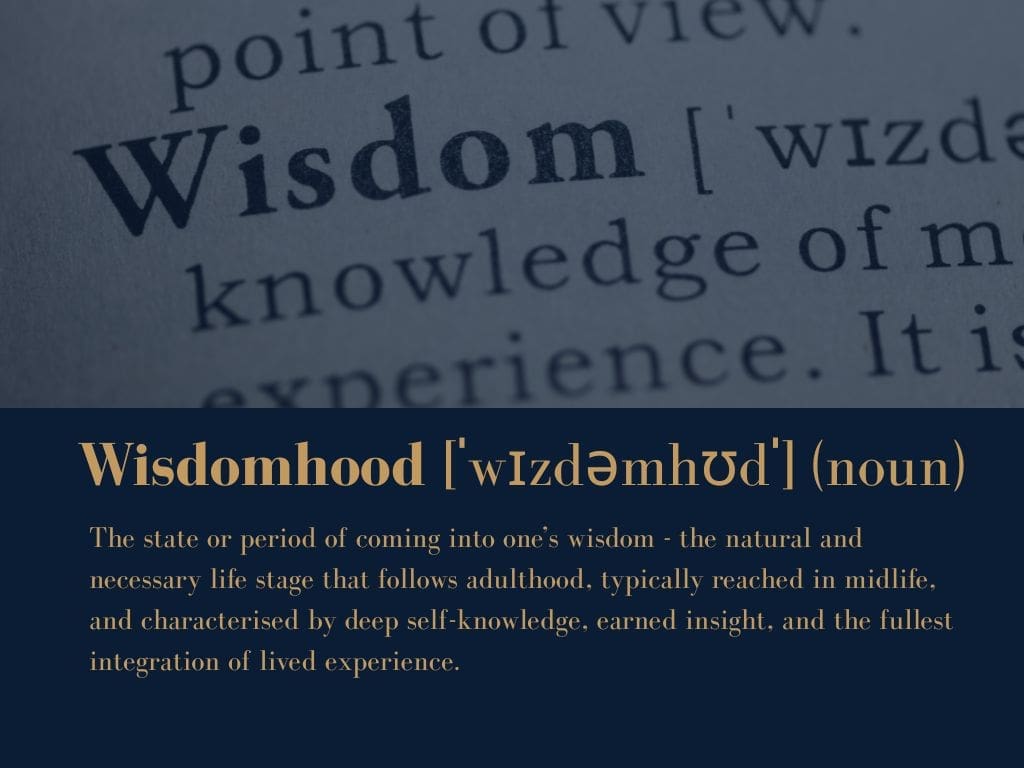
The state or period of coming into one’s wisdom; a life stage typically reached in midlife, characterised by deep self-knowledge, earned insight, and understanding fully integrated through lived experience. The natural transition from adulthood into the fullest expression of oneself.
The moment I wrote it down, something settled. The word felt like it had always been waiting, like it belonged to a shelf that had been empty for too long. It named something I had been feeling for years but struggling to articulate. And if I’d been struggling to find the words, I suspect I wasn’t the only one.
Then Something Extraordinary Happened
I went searching to make sure the word was truly unclaimed. And I found something that stopped me completely.
Wisdomhood already exists in the Oxford English Dictionary. Not as a current word. As an obsolete one.
Its earliest known use dates to before 1390, over 600 years ago, recorded in the writing of John Wyclif, the theologian and philosopher. The word lived briefly in Middle English and then quietly disappeared, unused and unclaimed, for six centuries.
Until today.
I didn’t coin wisdomhood. I resurrected it. And I think that matters enormously, because a word that was needed in 1390 and needed again in 2026 is not a coincidence. It’s a signal. It is the language trying to tell us something about what human beings, across centuries, have always needed to name.
Why This Word? Why Now?
I spent 10 years as a coroner. I investigated thousands of deaths. And the question that haunted me, the one that followed me home every single night wasn’t about the people who had died.
It was about the ones still living.
Were they actually living? Or were they just managing?
That question is what brought me to coaching. It’s what brought me to the women I work with: brilliant, capable, accomplished women in midlife who have spent decades looking after everyone else and have quietly, gradually, forgotten who they are.
These women are not broken. They’re not in crisis. They are in transition. They are standing at the threshold of wisdomhood, and nobody has given them the language, the map, or the permission to cross it.
That is what I’m here to change.
Wisdomhood is not about aging, it’s about awakening.
It is the life stage that begins when you stop measuring your worth by your productivity and start listening to the quieter, deeper voice that has been waiting patiently beneath the noise of your life. It is the transition from the doing of adulthood into the being of your fullest self. It is the stage nobody named. Until now.
And just as we understand that a child moves through childhood on the way to adulthood, we can now understand that an adult moves through midlife on the way to wisdomhood.
That reframe changes everything. The restlessness you feel is not a problem. The longing is not a crisis. The sense that something needs to change is not ingratitude.
It is your wisdomhood, calling you forward.
What Happens Next
Today I filed a trademark for wisdomhood in Australia. I secured the domain. And I submitted the word to the Oxford English Dictionary for reinstatement as a current, living word, with a definition fit for the people in midlife who need it most right now.
I’m excited to say that this small act has inspired my imagination.
But what it has done is it’s started a conversation that midlifers, particularly women, have needed for a very long time, finally equipped with the language it deserves.
If you are reading this and something in you has recognised itself in these words — if you have felt the pull of wisdomhood without having a name for it until now, I want you to know you aren’t lost, you’re not falling apart and you’re not too late.
You are transitioning. You are arriving. And you are exactly where you need to be.
Welcome to wisdomhood.
Jacqui Hawkins is the founder of Lit Within and the creator of the Wisdomhood movement. She is a former coroner, women’s empowerment coach. To stay connected follow Lit Within at @litwithincoaching.
© Jacqui Hawkins, Lit Within, 14 June 2026. All rights reserved.

Comments +